
From Solo to Social Learning: Characterizing Recursive Social Improvement in LLMs
Published in Preprint. In-review, 2026
Kunal Jha, Max Kleiman-Weiner*, Natasha Jaques*
Preprint. In-review
Paper · PDF · Code · Citation
LLMs can rewrite the instructions they follow and improve their own skills. But how good are they at learning from each other? In this work, we ask whether access to peers’ discoveries helps self-improving agents learn better than they would alone. We call this capability recursive social improvement: agents copy useful skills, revise them, and make those revisions available for others to build on.
Our main finding is a tension: copying can make learning more efficient, but today’s LLMs do not reliably turn that advantage into better performance at the same cost. Useful discoveries spread, yet populations often converge on their peers’ choices before exploring enough alternatives.
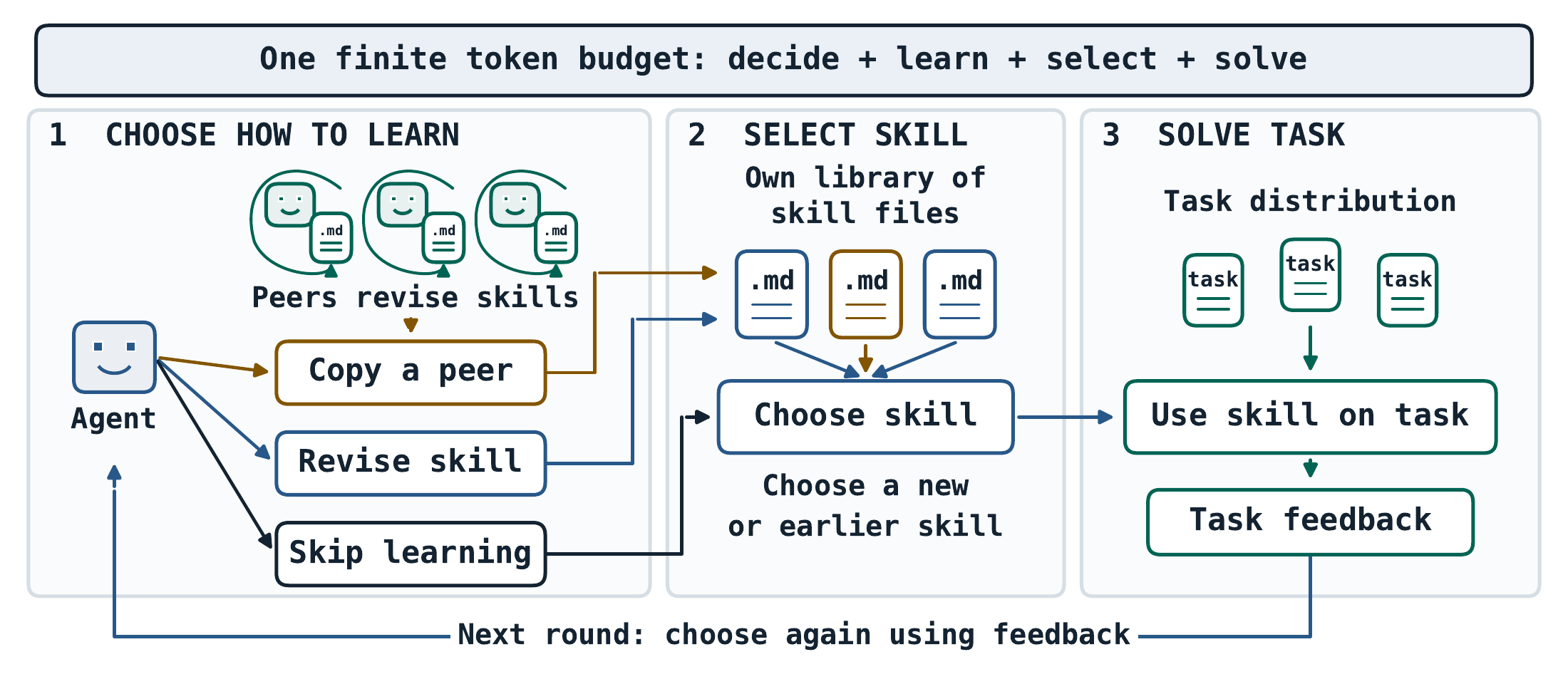
Who keeps exploring when everyone can copy?
A peer’s discovery can save an agent from starting from scratch. But if everyone follows what others have found, who keeps exploring? This is an old tension from cultural evolution and economics: copying is useful only if someone else pays the cost of discovery.
We compare social and solo populations under the same token budget, counting the search behind every copied skill. This matters because a copied solution may be cheap for its recipient while still requiring substantial work elsewhere in the population. Our question is whether access to peers improves the population’s reward at matched computational cost.
A simple social learning tournament
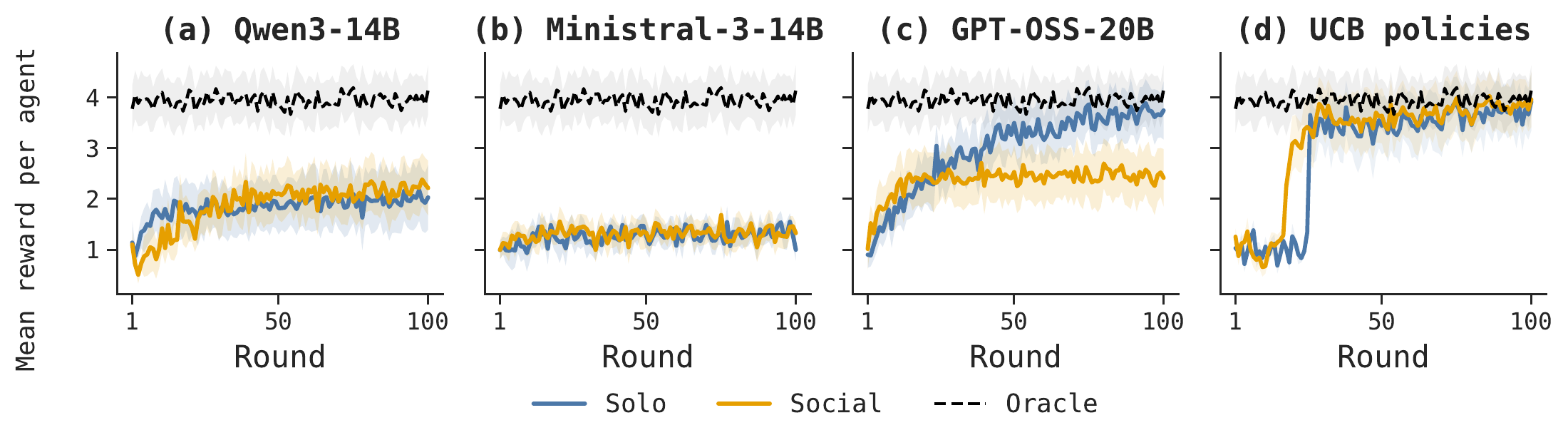
We begin with a controlled environment where agents choose whether to observe a peer or act on a reward-bearing option. Observation and action draw from the same token allowance. A hand-designed social learner, hierarchical UCB, benefits from peers, showing that social information can help in this setting.
Qwen3-14B, Ministral-3-14B, and GPT-OSS-20B do not realize the same benefit. In the primary comparison, they earn 30–52% less reward per token when they can observe peers.
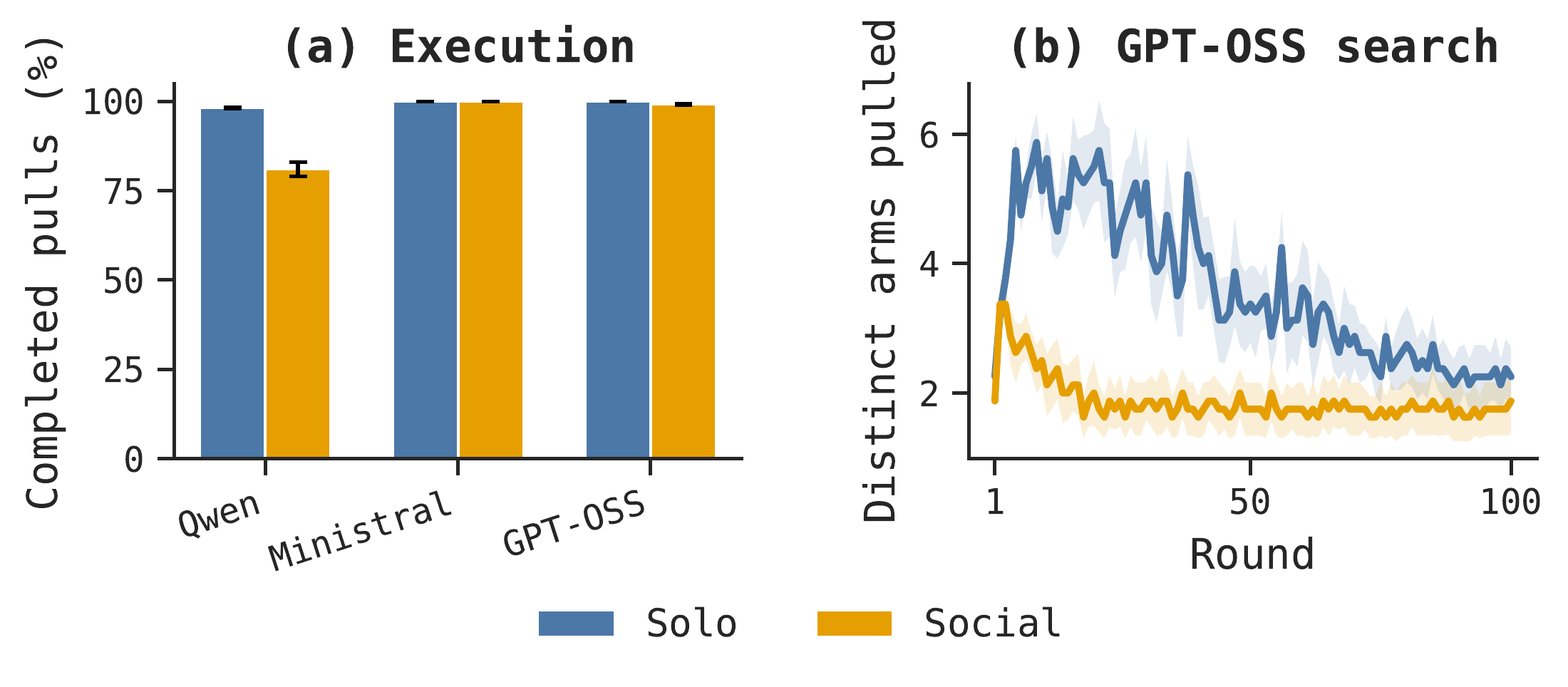
Useful information, narrow exploration
The problem is not simply that agents copy bad options. For GPT-OSS, a copied option beats the agent’s own best discovery 93% of the time. Instead, social populations concentrate on what peers are already doing and explore fewer alternatives. Some agents also spend so many tokens deciding whom to copy that they run out before acting.
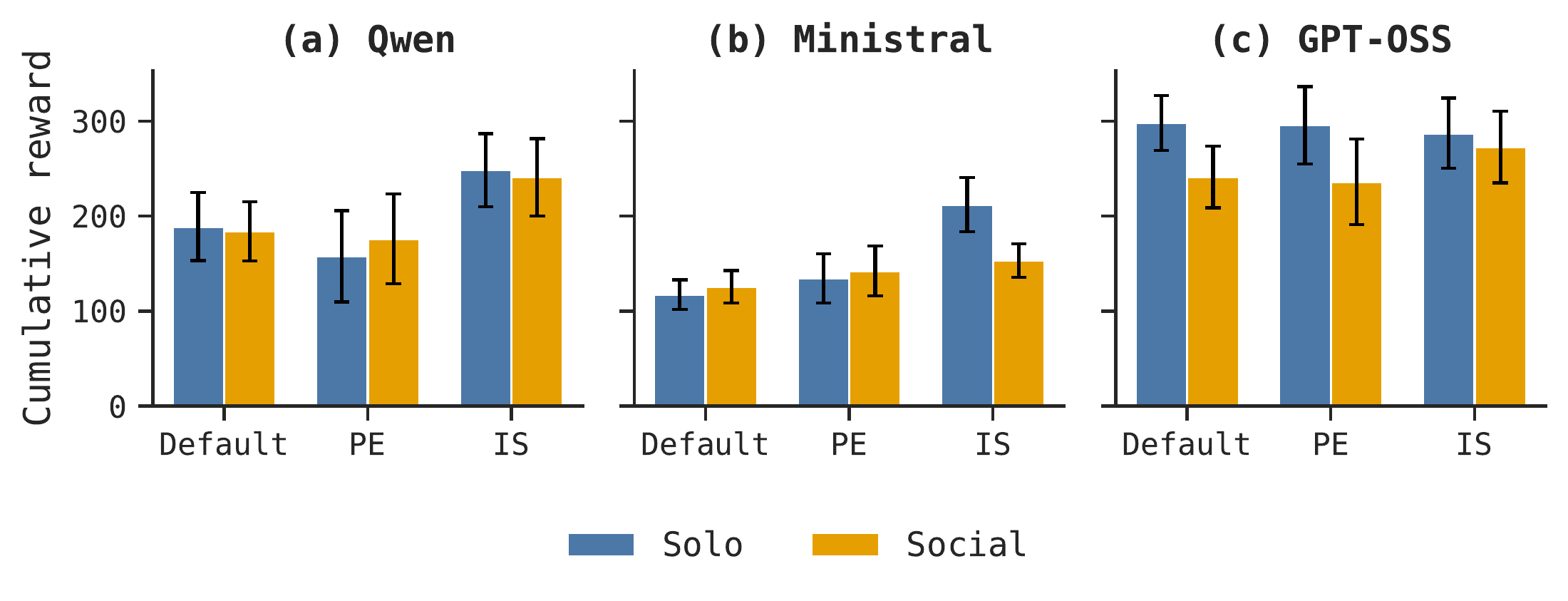
We intervene on both problems directly. Protected execution (PE) reserves tokens for acting, while independent search (IS) forces agents to explore on their own. Each intervention improves its targeted behavior, but neither makes social learners reliably outperform equally treated solo learners. Access to useful information is only part of the challenge; agents must also balance observation, exploration, and execution.
From choosing options to evolving skill files
Next, we let agents write, revise, and share their own skill files on IFBench, an instruction-following benchmark. Each agent maintains a library of reusable instructions and chooses which version to deploy. Peers can copy a file, revise it again, and pass that revision onward.
Social access changes how models improve. GLM-5.3-Flash finds useful skills sooner, while GPT-OSS-120B uses roughly a third fewer learning tokens. Yet at matched learning cost, neither model outperforms independent learners. Copying can save effort without making the final solution better.
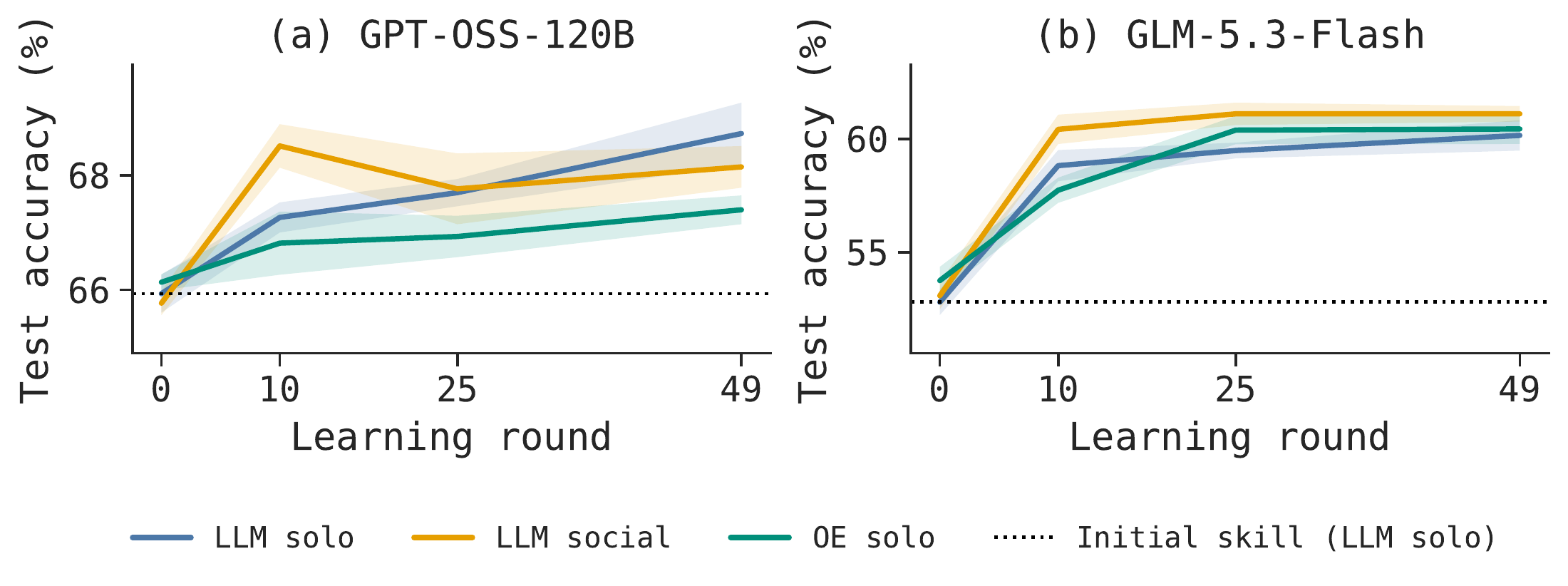
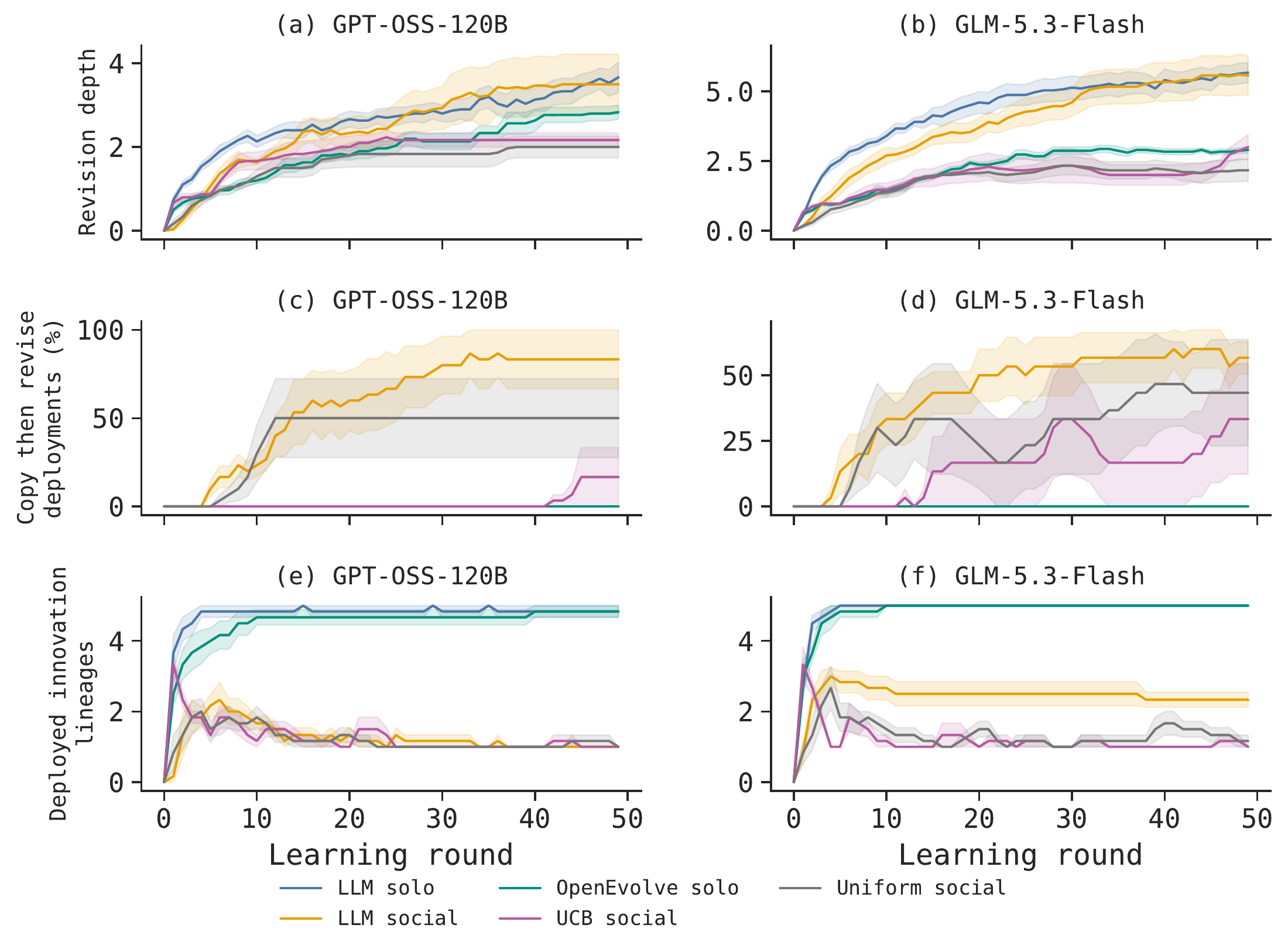
Skills spread, but independent discoveries disappear
Skills really do get passed on: agents copy a peer’s revision, revise it, and make it available to another agent. These chains show that a single discovery can seed further search across the population.
But exchange also concentrates the population around fewer founding discoveries. Solo populations retain about five independent skill lineages. By the end, GPT-OSS social populations retain about one, and GLM social populations about two. These are recorded acquisition lineages of deployed skills, rather than every possible ancestry path to identical content.
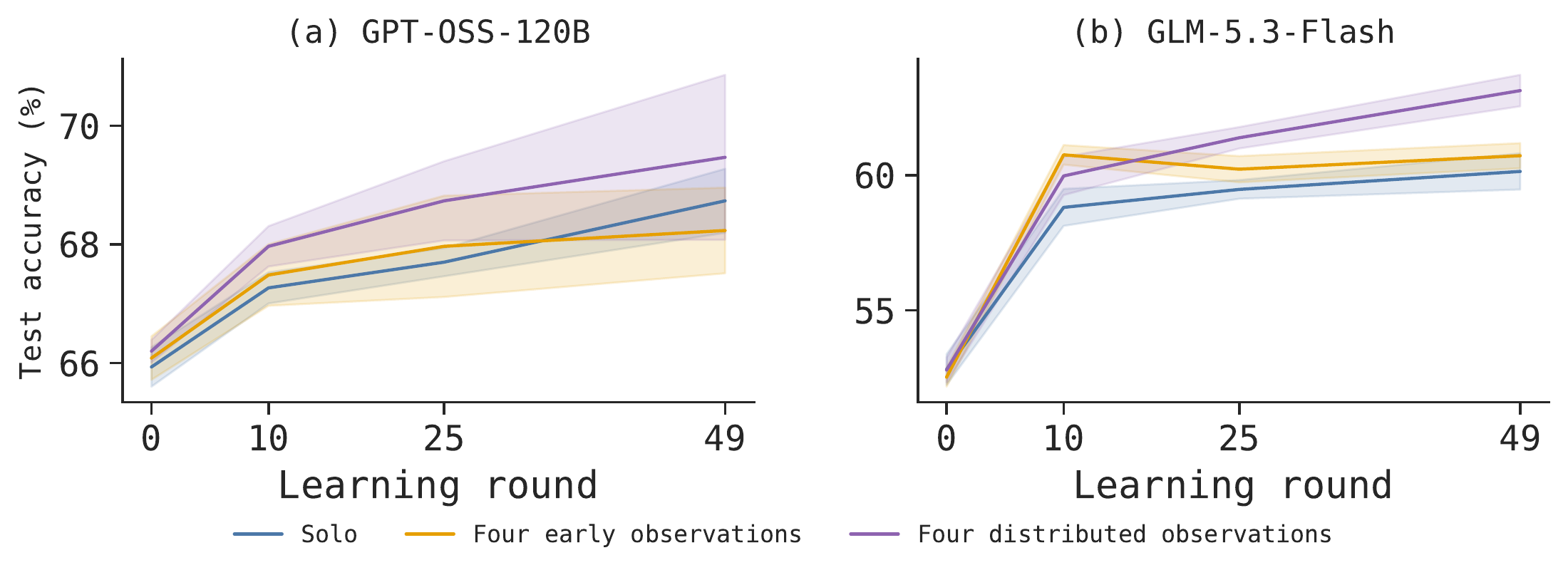
When agents copy matters
Holding the number of observations fixed reveals another piece of the puzzle. With the same four observations, distributing them across learning outperforms copying early. For GLM, distributed observations improve final accuracy by 2.4 percentage points over early copying, and 3.0 points over solo learning in this timing intervention.
Waiting gives peers time to produce something worth copying. This controlled result shows that a better observation schedule can help, even though unrestricted, model-directed social learning does not reliably produce a matched-cost advantage.
Learning from peers is a capability of its own
As more self-interested agents improve side by side, using peers’ discoveries well becomes a capability in its own right. Today’s LLMs can copy useful work and build on it, but do not yet balance independent exploration and observation well enough to consistently outperform learning alone at the same cost.
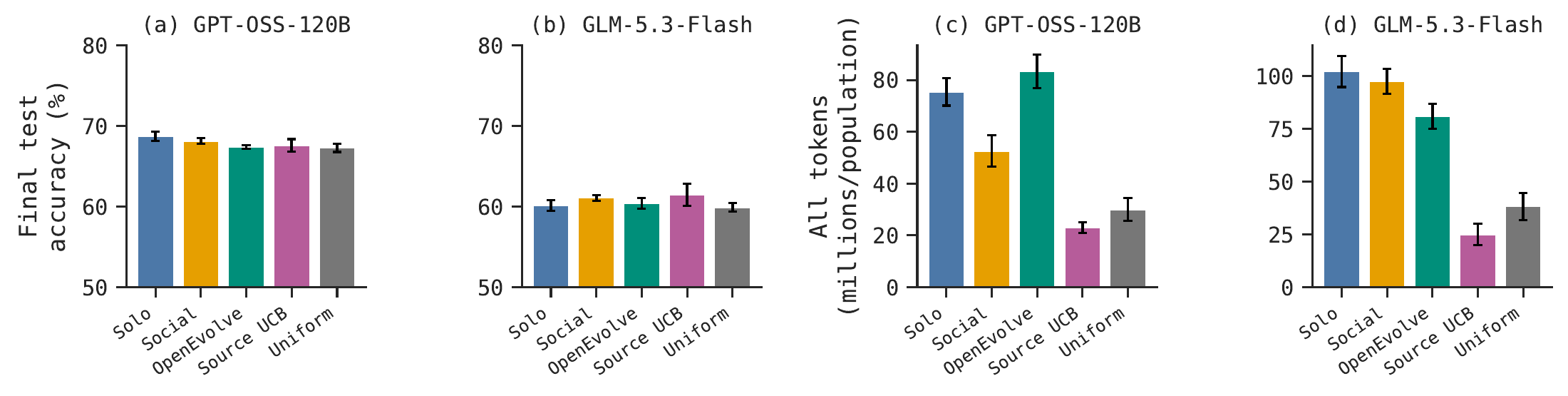
More efficient, but not yet more effective. Training agents to decide whether, when, and whom to copy is an exciting next step toward recursive social improvement.
Explore the experiments in our paper and code repository.
Citation
@article{jha2026solo2social,
  title={From Solo to Social Learning: Characterizing Recursive Social Improvement in LLMs},
  author={Jha, Kunal and Kleiman-Weiner, Max and Jaques, Natasha},
  journal={arXiv preprint arXiv:2609.38516},
  year={2026},
  url={https://arxiv.org/abs/2609.38516}
}